🃏 Sales Enablement Game
A Roguelike Battle Cards Training Game
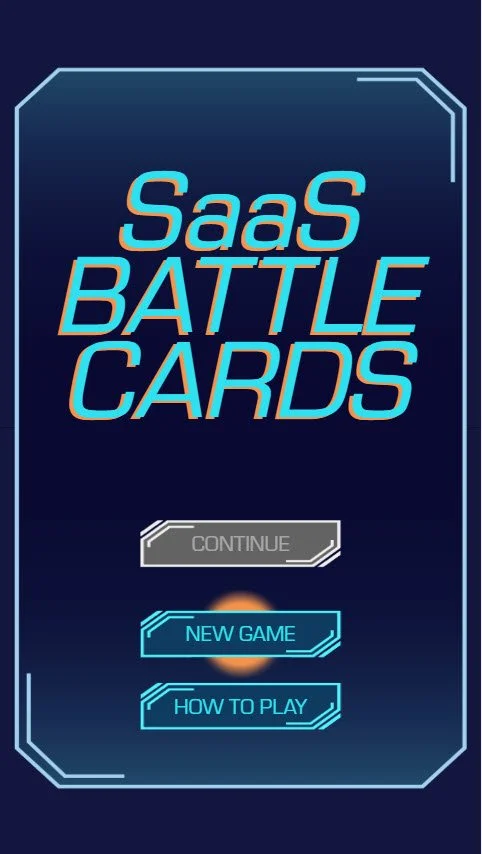
Inspired by Balatro, SaaS Battle Cards is a mobile, roguelike card game for account execs to practice sales strategies on-the-go. Designed with 3 generative AI models (LLMs) & built in Storyline 360 over 3 weeks in my spare time, it demonstrates my ability to create innovative sales enablement tools by combining sales domain expertise with advanced development skills.
The Challenge
Traditional sales training courses teach scripts, but not necessarily adaptive thinking under pressure.
Role-play can feel artificial. Branching eLearning rarely captures the chaos of a live objection. And most "gamified" learning is just points and badges—no strategic gameplay.
Account Executives need to recognize objection patterns, select optimal counter-tactics in context, and recover from imperfect plays. I wanted to test whether a true strategy game could train those skills more effectively than traditional methods.
The Solution: Games, Not Gamification
SaaS Battle Cards uses turn-based combat where customer objections are "attacks" and sales tactics are playable cards.
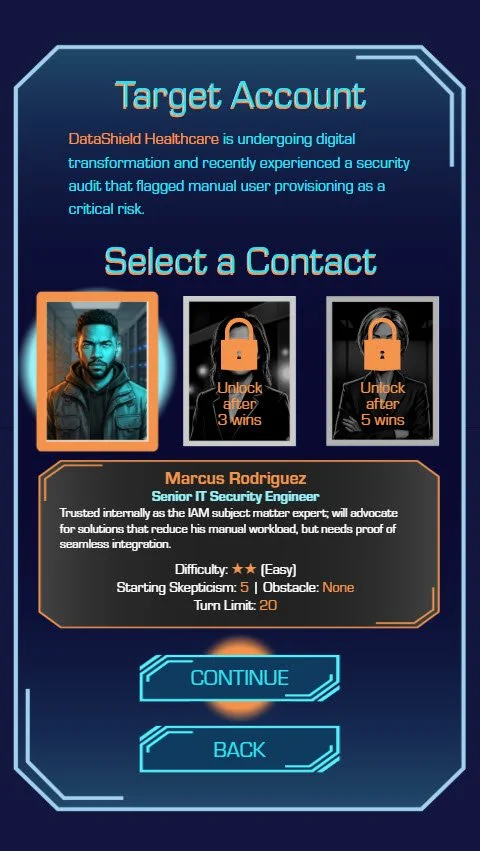
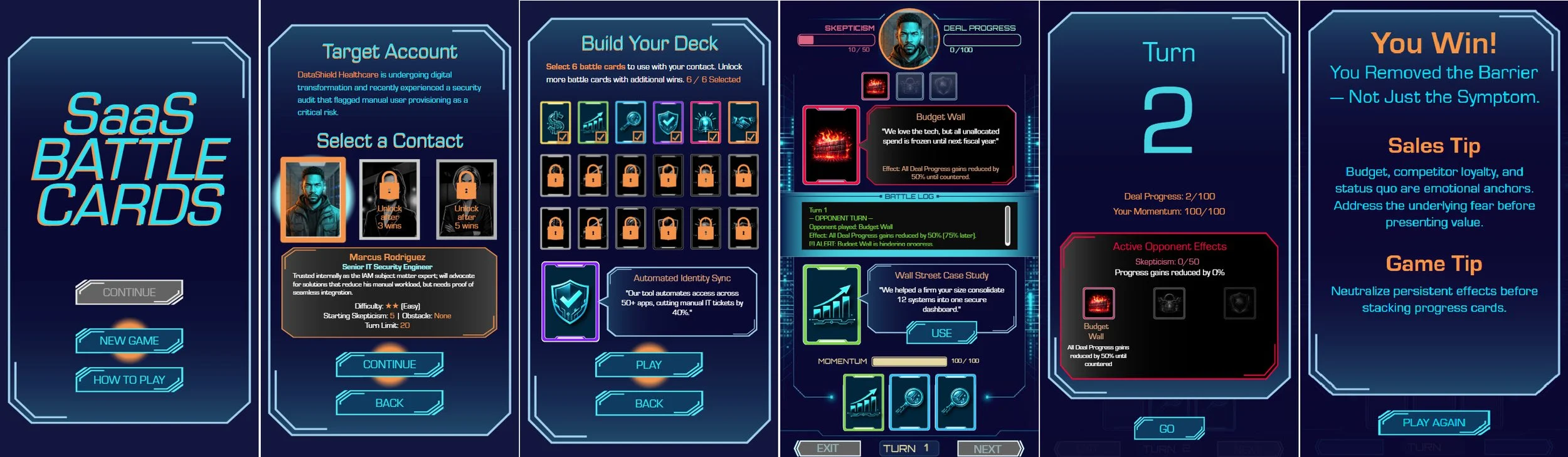
Players select their stakeholder—in this prototype, Marcus Rodriguez (Senior IT Security Engineer) an easy-difficulty contact with no active starting obstacles and Skepticism at level 10. Two additional personas are mocked up as locked content to demonstrate scalability.
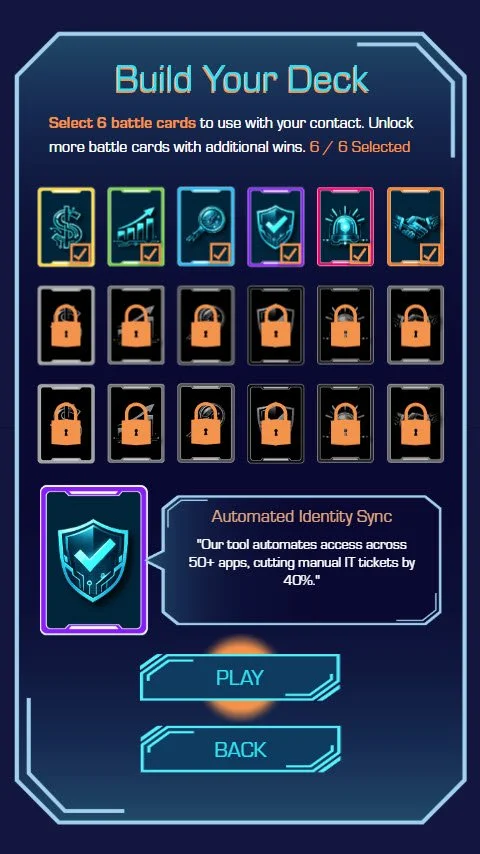
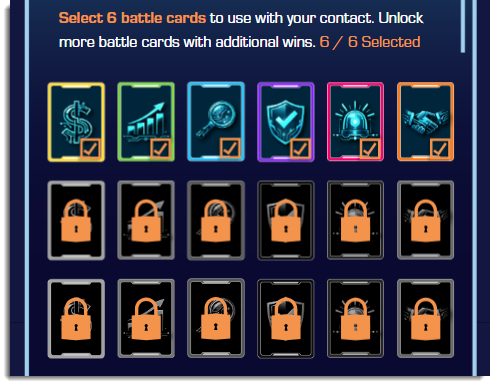
Next comes deck building. The interface displays an array of 18 possible cards—six are currently unlocked, twelve are locked for future expansion. Players click cards to view descriptions, then select their six-card starting deck. While this feature is designed but not yet functional in the prototype, it demonstrates how a production version would let AEs prepare strategically based on their chosen contact.
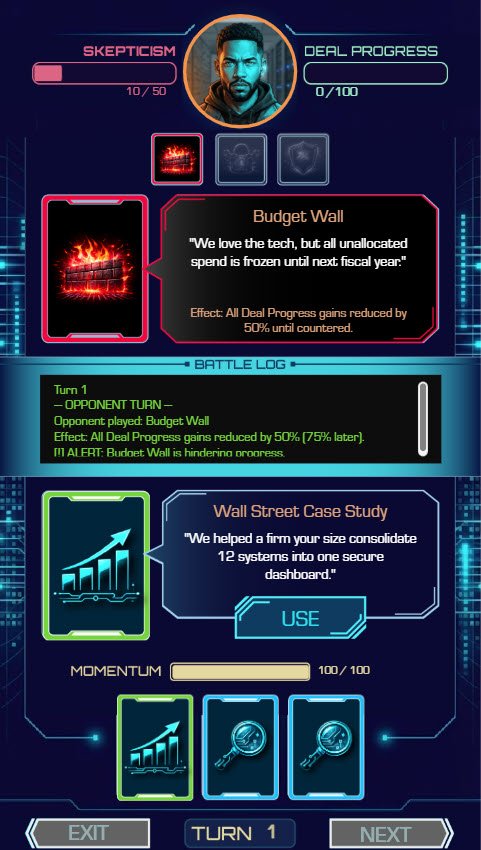
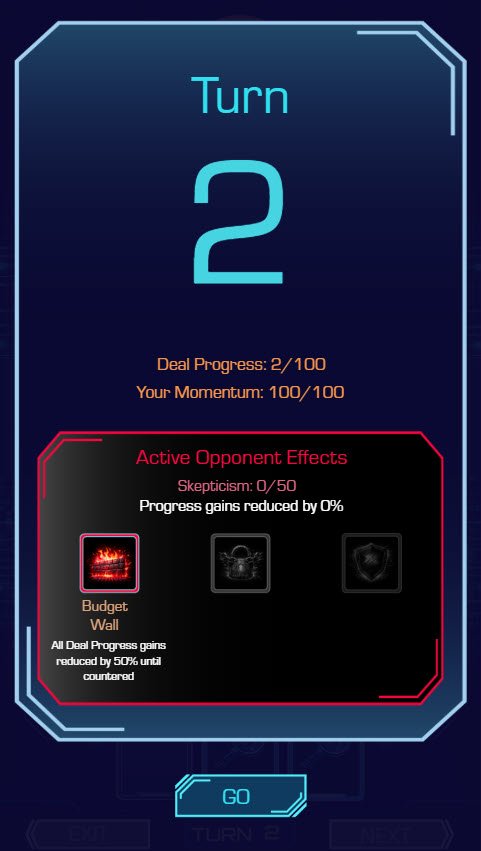
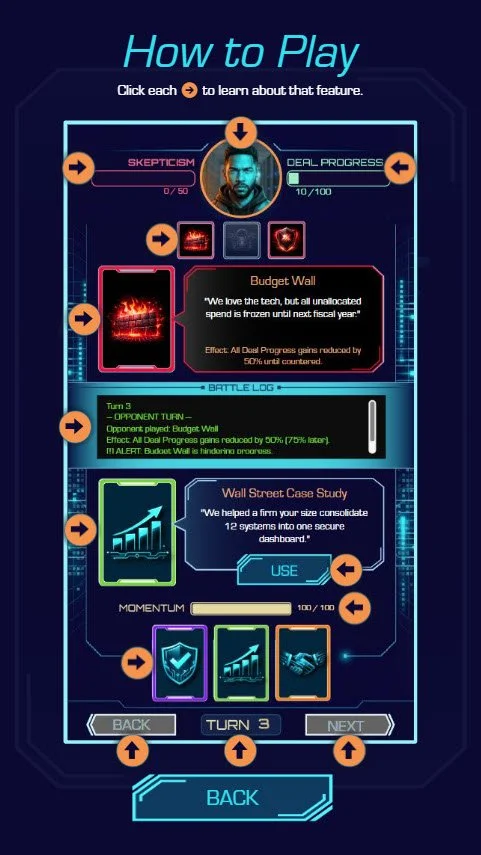
The battle screen tracks three live indicators:
Momentum (your credibility—lose it all and the call ends)
Deal Progress (reach 100 to win)
Skepticism (reduces the impact of all your tactics)
Strategic depth comes from interaction bonuses. Playing any card works, but playing the right card against the right obstacle triggers amplified effects:
Budget Wall → ROI Calculator (destroys the shield)
Status Quo Comfort → Case Study (stops ongoing damage + lowers Skepticism)
Security Auditor → Case Study (converts damage into progress)
The game teaches pattern recognition: budget objections need financial proof, technical skepticism needs credibility, and relationship barriers need discovery questions.
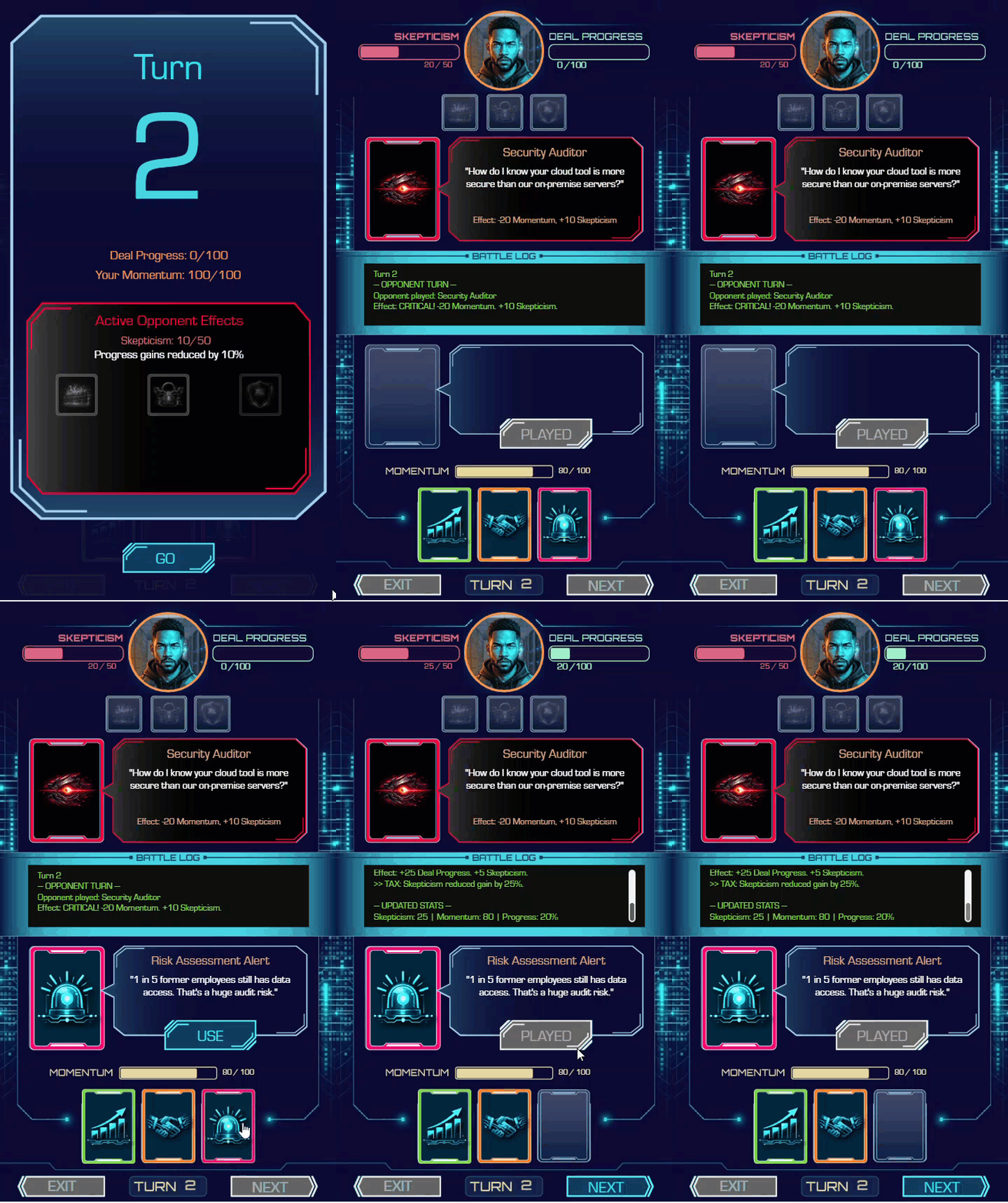
The Battle Log auto-updates in real-time, creating a running record of the conversation and reinforcing cause-and-effect learning.
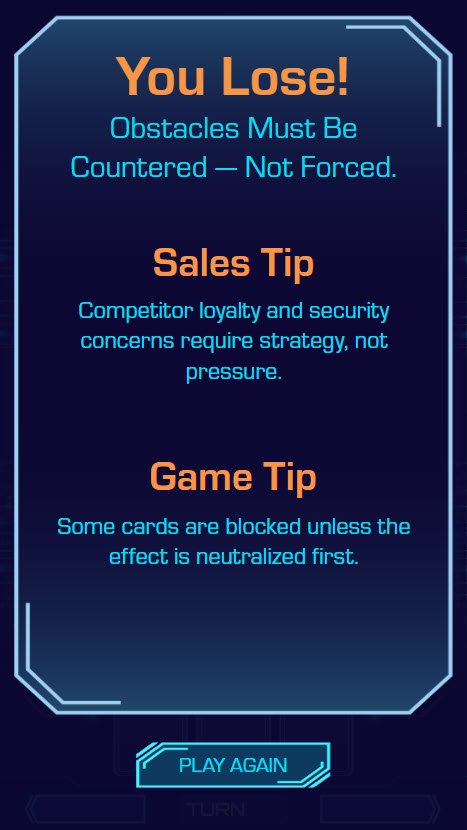
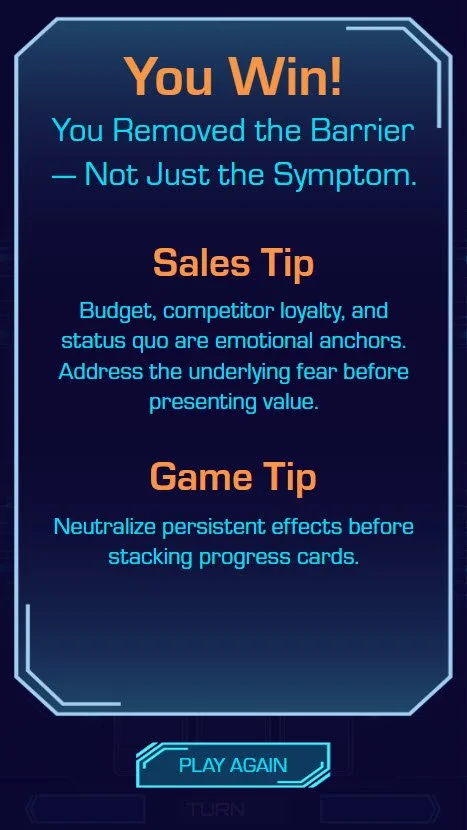
Win and loss screens deliver diagnostic feedback—not just "Try again." Each outcome includes a performance summary, a Sales Tip (real-world guidance), and a Game Tip (tactical improvement).
In SaaS Battle Cards, failure becomes data for the next contact.
Instructional Design Approach
This project is built on three principles that traditional sales training may miss:
Safe Failure Environment
The roguelike format expects multiple runs. Players experiment with high-risk tactics without real-world consequences. Losing becomes part of the learning cycle.
Spaced Retrieval Practice
Obstacles appear in randomly across games. Players must repeatedly retrieve the correct counter-strategy so recognition becomes automatic. No memorized "perfect path"—adaptation is required.
Immediate Feedback Loops
Every action produces instant quantitative (meter changes) and qualitative (Battle Log updates) feedback. The tight action-outcome loop accelerates skill development.
Development Process
Building a functional strategy game in Storyline required pushing the platform well beyond typical use.
Advanced Storyline + JavaScript
Two technical challenges stood out:
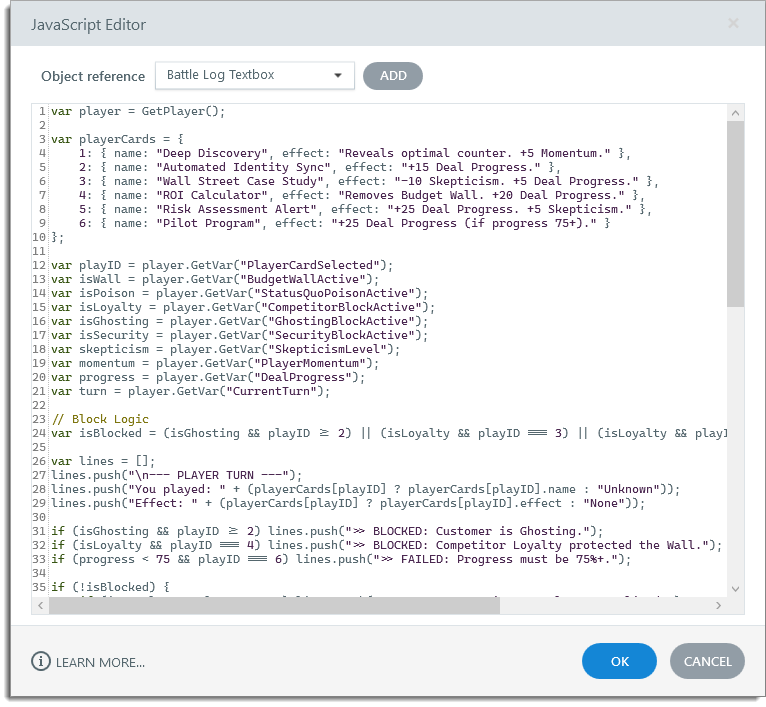
Real-time scaling indicator bars - Storyline's native triggers couldn't handle smooth updates as variables changed mid-game. I used JavaScript to dynamically calculate and update bar widths for fluid visual feedback.
Auto-scrolling Battle Log - As gameplay appended text entries, the log needed to scroll automatically so players never missed updates. This required JavaScript DOM manipulation beyond Storyline's default controls.
Scalable Architecture
This was intentionally scoped as a rapid prototype. Storyline isn't the ideal platform for a production mobile game, but it's excellent for fast, web-deployable proof-of-concept.
The architecture supports natural expansion. Current roadmap:
Accessibility - Interactions based on clicking instead of dragging makes this feasible
User authentication for cross-device saves
xAPI for analytics
Multiple contact personas with unique starting conditions
Expanded card collections across six strategic categories
Progressive unlocking and deck-building mechanics to support effective sales techniques (MEDDIC/MEDDPICC, SPIN, etc.)
Campaign mode with multi-stakeholder deals
In-game currency systems for power-ups, expansion, unlocking features.
In-game tutoring system that can be toggled on/off
Customize sales strategy cards and contact characteristics by importing spreadsheets
Customize branding
Music and sound effects
Improved art direction
Contact unlocking and card expansion are designed but not built—demonstrating product roadmap thinking without scope creep.
Strategic Generative-AI Workflow
I used three LLMs intentionally for different strengths:
Claude - Primary partner for JavaScript development and Storyline troubleshooting
Claude, Gemini, & ChatGPT - Sales enablement research, strategy refinement, and game balance testing
Gemini's Nano Banana - Visual asset generation (board, avatars, icons, obstacle cards)
Instead of limiting AI to content generation, I balanced the strengths of multiple models in a structured workflow to boost my abilities and production speed for domain research, game strategy, vibe coding, and technical development.
Results & Impact
Following a recent interview, the hiring manager tole me that she shared the game with her team. That reaction validated the core goal: build something that sparks conversation and demonstrates I can create tools that sales teams would actually use.
The “How to Play” tutorial system uses interactive markers to explain each interface element—a model for how onboarding could scale in production.
Key Takeaways
This project demonstrates capabilities that extend beyond traditional instructional design:
Sales Enablement Expertise - Obstacle types (Budget Wall, Status Quo Comfort, Security Auditor) map directly to real objection categories. Card mechanics reflect actual sales frameworks.
Games vs. Gamification - Strategic gameplay with emergent decision-making, not just a quiz with a leaderboard.
Advanced Storyline Development - Variable logic, JavaScript integration, real-time UI updates, custom object manipulation.
Strategic AI Integration - Purpose-driven use of multiple LLMs as specialized tools, not generic "AI helped me."
Product Thinking - Scalable architecture and clear roadmap vision for production expansion.
Tools I Used
Authoring, Development, and QA: Articulate Storyline 360, JavaScript (AI-assisted), Review 360
Design and Docs: Illustrator, Google Sheets, Google Docs
Generative-AI LLMs: Claude, Gemini, Nano-Banana (Gemini), ChatGPT
Hosting: AWS S3
Connect With Me
If you're exploring new approaches to sales enablement and want to discuss building something similar for your team, let's talk.
🏴☠️ Fun Fact:
“AI AI, Captain!” I enjoy partnering with co-intelligent AI tools to boost efficiency, spark creativity, sharpen accuracy, and streamline complex work. Embracing AI as a creative collaborator has been key to keeping projects innovative, scalable, and future-ready.